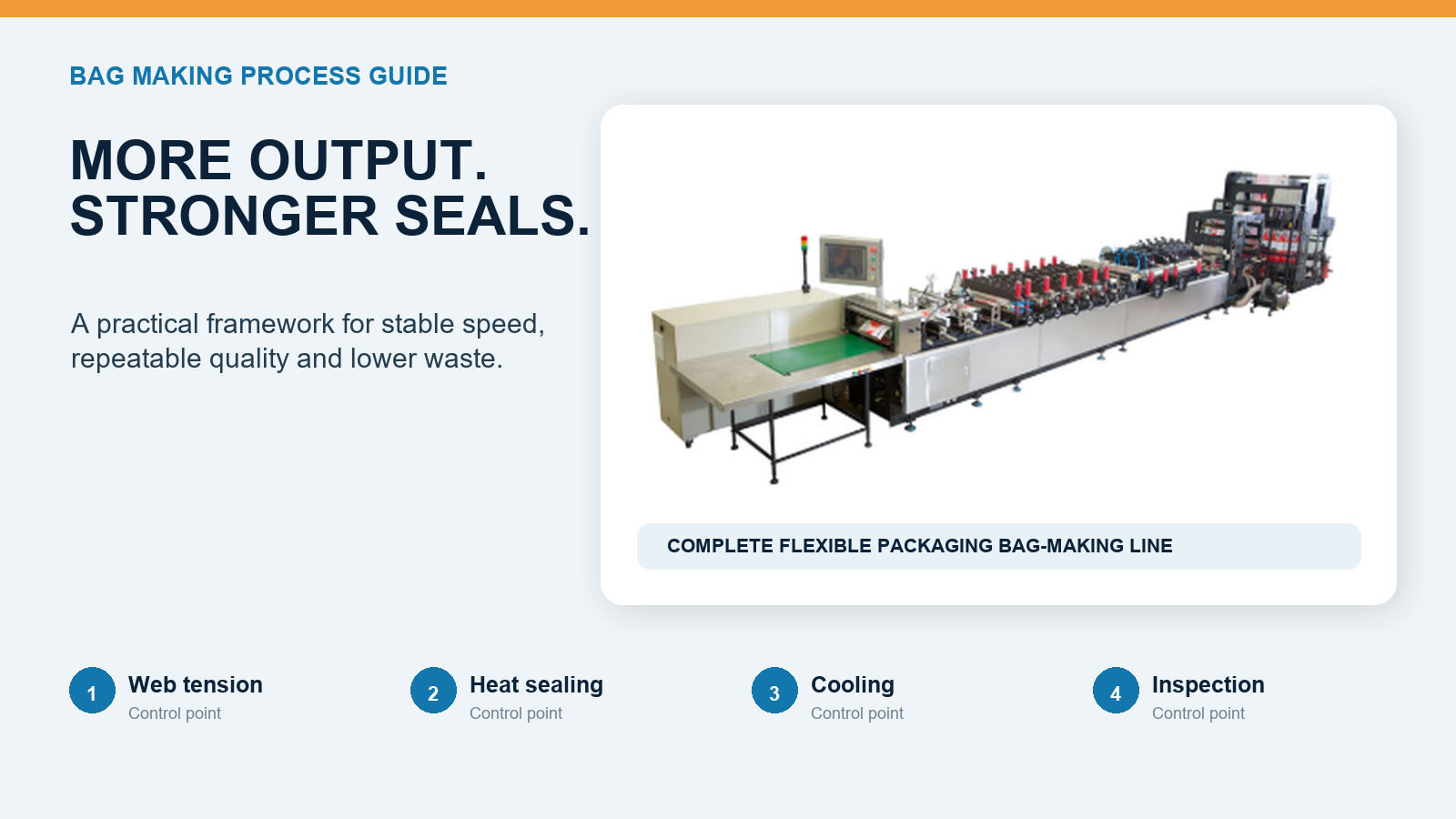
Bag making converts printed or unprinted rollstock into the package that a customer fills, seals, ships, and places on a shelf. It is the final converting step, but it should not be treated as a simple finishing operation. Film tension, registration, sealing, cooling, cutting, and downstream handling all meet at this stage. A small error can affect the bag’s appearance, dimensions, opening performance, seal integrity, or ability to survive distribution.
The most effective improvement programs therefore connect production speed with process stability. A line that runs faster but creates more start-up waste, unplanned stops, or seal failures may produce fewer saleable bags per shift. Plants should measure good output, changeover time, material loss, and defect causes together.
Why the bag making process matters
Flexible formats and shorter production runs
A modern bag making line can support three-side-seal pouches, center-seal bags, stand-up pouches, zipper pouches, flat-bottom formats, shaped bags, and other structures when the machine configuration matches the required process. Adjustable web paths, sealing stations, cutting systems, and attachments allow one production platform to cover more than one size or format.
This flexibility has become more valuable as converters handle shorter orders and more frequent design changes. The equipment must still be assessed against the actual product mix. A line that changes quickly between two similar pouch sizes may need additional tooling, web-path changes, or set-up time when it switches to a different structure.
Functions added during converting
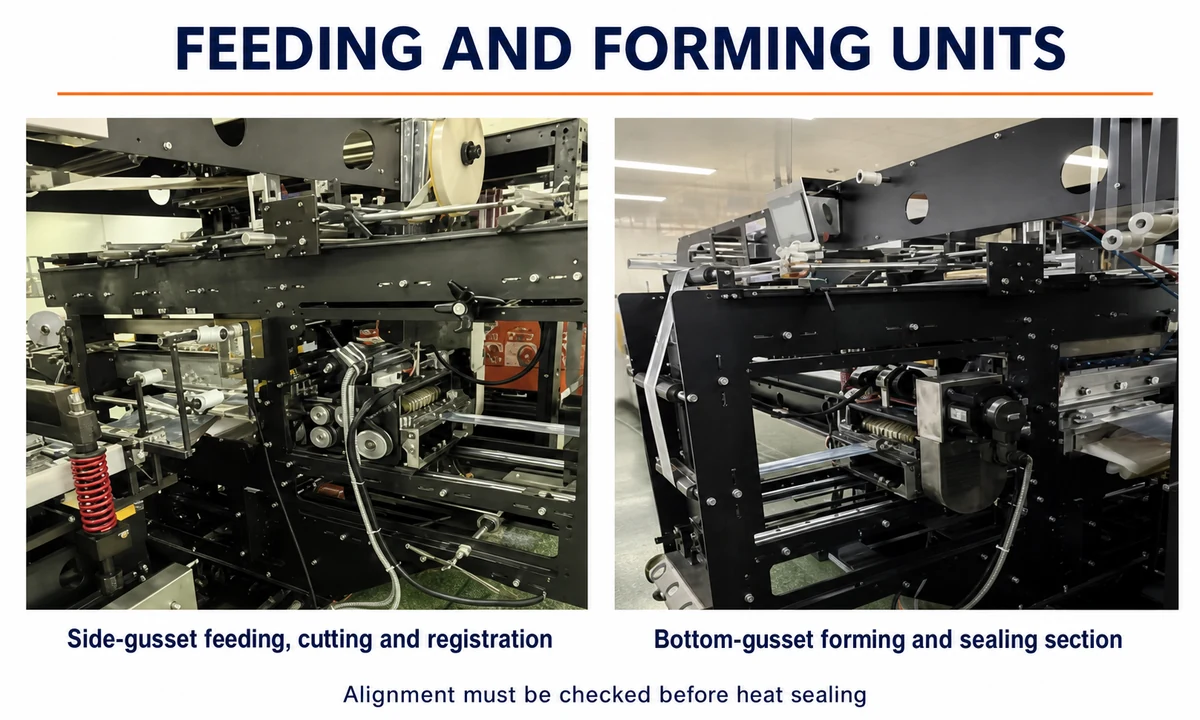
Bag making can combine sealing, cutting, gusset forming, zipper insertion, hole punching, tear features, spout-related preparation, and other finishing operations. Integrating these steps can reduce secondary handling and work-in-process inventory. It also reduces the number of times operators must move or realign semi-finished material.
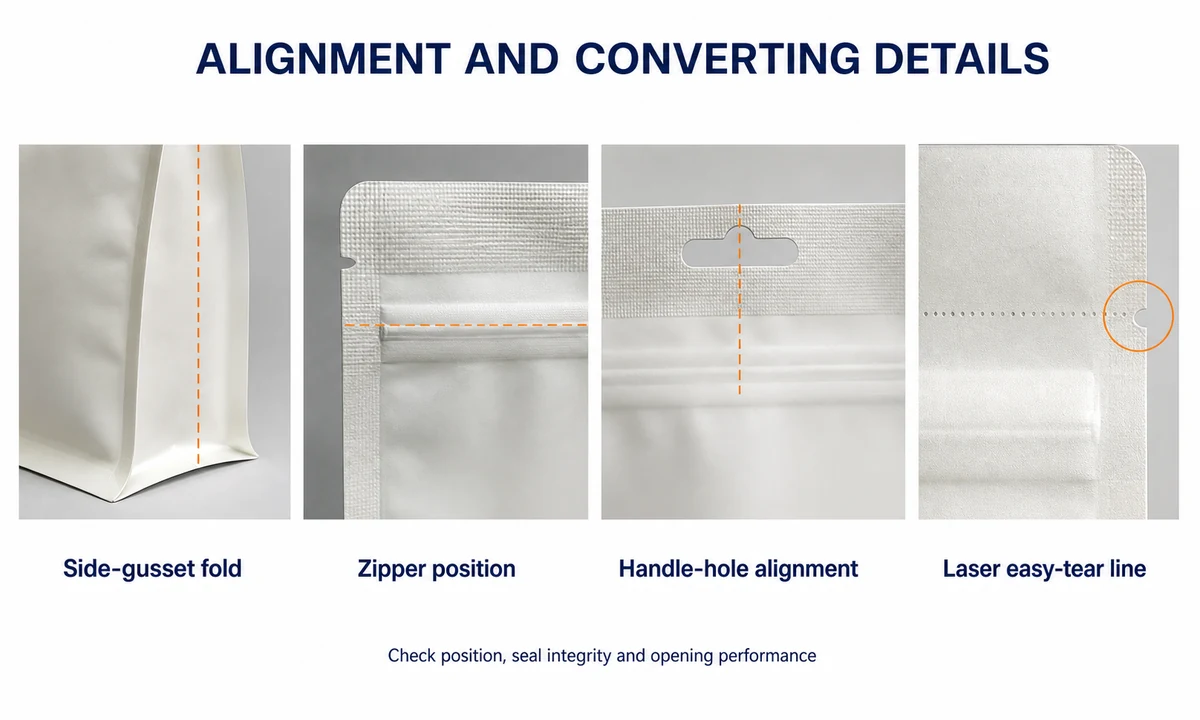
Each added function introduces another control point. For example, a zipper must remain aligned with the seal area, a tear notch must avoid weakening a critical seal, and a punch must stay synchronized with print registration. The value of integration depends on how reliably the machine coordinates those functions at production speed.
Package protection and consistent quality
The finished pouch must preserve the barrier performance designed into the laminate. Heat sealing creates the package closure, while cooling fixes the seal geometry before the web encounters the next guide, nip, or cutting station. Poor control can produce channels, wrinkles, distorted edges, weak hot tack, or local damage to the sealant layer.
Automatic temperature, pressure, registration, and length control can make output more consistent than manual fabrication. Automation does not remove the need for process knowledge. Operators still need a validated operating window for each material structure and bag format.
Material, storage, and logistics efficiency
Rollstock normally occupies less storage and transport volume than preformed rigid containers. Converters can also schedule pouch production closer to demand, which reduces finished-goods inventory. Standardized cutting, multi-lane production, and automatic stacking can lower labor and material cost when the line runs within a stable process window.
The useful cost measure is cost per accepted bag. It should include film consumption, trim waste, start-up loss, labor, maintenance, energy, and rejected production. A higher nominal machine speed does not guarantee a lower unit cost.
Equipment and automation improvements
Stable speed before maximum speed
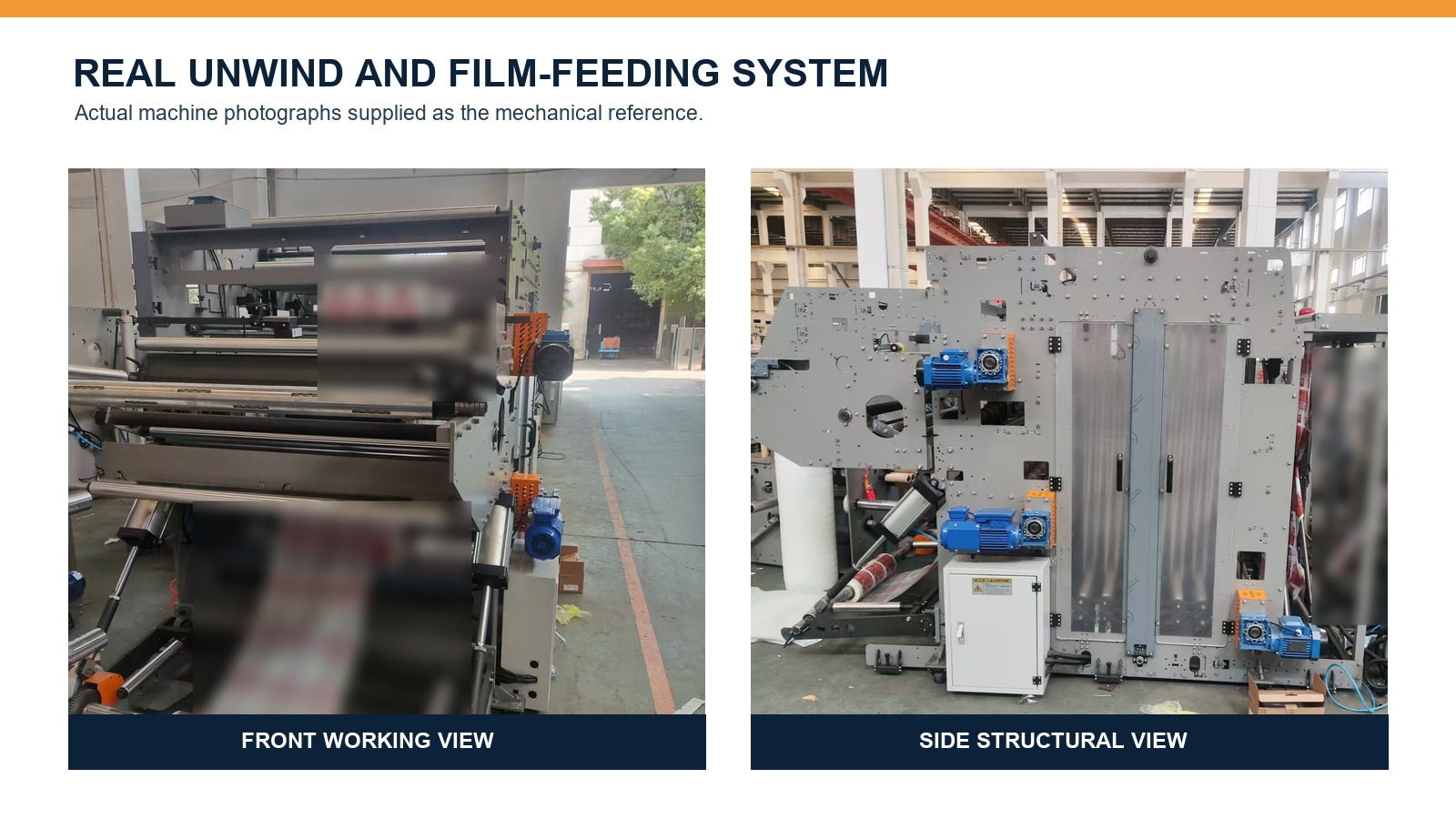
Servo drives can improve bag-length control and reduce mechanical transmission error. Closed-loop web tension and web guiding help prevent lateral movement and wrinkles as the machine accelerates. These systems should work as one coordinated web-handling process. Aggressive corrections from one control loop can disturb another section of the machine.
Machine speed should be stated carefully. Suppliers may quote cycles per minute, bags per minute, or web speed. The result changes with bag length, lane count, material stiffness, seal dwell requirement, attachments, and stacking method. Buyers should request proven output for a comparable pouch and film structure, together with the acceptable waste and defect rate.
Recipe management and production data
A PLC and human-machine interface can store temperature zones, bag length, registration settings, tension values, and attachment positions as a product recipe. A reliable recipe shortens repeat-order set-up because the operator starts from a known condition instead of rebuilding every parameter.
Data collection becomes useful when it helps supervisors explain lost production. Start-up waste, alarm history, downtime reason, speed loss, and quality holds should use consistent definitions. A dashboard alone will not improve performance if operators still record different reasons for the same fault.
Integrated stations
Combining zipper application, punching, tear features, folding, and other operations on one line can reduce labor and intermediate handling. Integration works best when each unit can be isolated for set-up, cleaned safely, and bypassed when the product does not require it. Tool access and changeover ergonomics matter as much as the number of available functions.
Material compatibility
Thin and high-strength structures
Thinner laminates reduce material use, but they provide less margin for uneven pressure, excessive temperature, or poor web control. Sealing jaws need uniform contact across the working width. Heating and cooling systems should limit local temperature variation, particularly on wide or multi-lane machines.
CPP, conventional PE, metallocene PE, coextruded films, and laminated structures have different seal initiation temperatures, hot-tack behavior, friction, and stiffness. The machine should provide enough control range to establish a stable seal without damaging the printed web or deforming the pouch.
Recyclable and lower-impact materials
Mono-material PE or PP structures can improve mechanical recyclability, but they may narrow the processing window compared with some conventional laminates. Heat resistance in the outer layer, seal initiation in the inner layer, web stretch, and coefficient of friction all affect machine performance.
Biobased or biodegradable films also require material-specific trials. Some structures may stick to hot tooling, stretch under tension, or lose seal strength when temperature and dwell time drift. Plants should qualify these materials with the intended pouch geometry, filling process, and distribution conditions instead of relying on a generic material label.
Heat sealing, cooling, and forming control
A validated sealing window
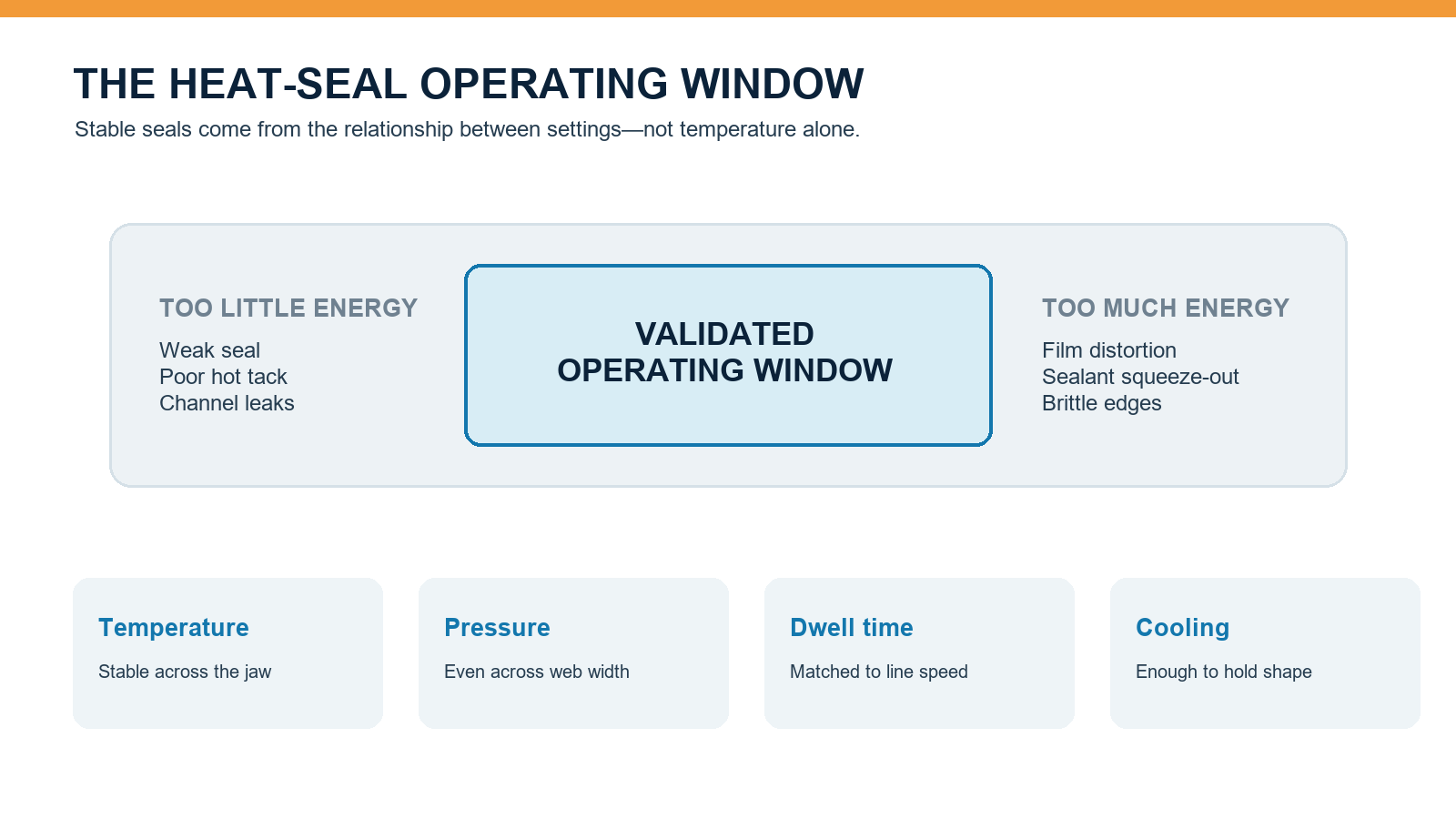
Seal quality depends on the relationship among temperature, pressure, dwell time, jaw condition, and material structure. Raising temperature alone may appear to solve a weak seal, but excessive heat can distort the film, squeeze the sealant away from the joint, or create a brittle edge. Pressure must remain even across the jaw, and the contact surface must stay clean and correctly aligned.
Plants should define an operating range rather than a single target. The range should account for normal material variation and expected line-speed changes. Routine checks can include seal strength, visual appearance, dimensional accuracy, leak performance, and opening behavior according to the customer’s application.
Cooling and shape retention
The pouch remains vulnerable immediately after heat sealing. Adequate cooling supports hot-tack development and helps the bag stay flat. Cooling rolls, plates, or air systems need sufficient contact time and even heat removal. Thick structures, demanding seal patterns, and higher speeds may require a longer cooling path or additional cooling capacity.
Weak cooling can cause shrinkage, curl, edge lift, or dimensional drift. These symptoms sometimes look like cutting or registration faults, so troubleshooting should examine the thermal history before adjusting mechanical positions.
Cutting and appearance
A stable web, sharp tooling, and synchronized motion reduce ragged edges, length variation, and registration error. Operators should inspect knife condition, clearance, anvil condition, static, and web support. Replacing a worn blade may solve a fault that software compensation cannot correct.
Waste and cost reduction
Lower start-up loss
A controlled start sequence allows the web to stabilize before full speed. Automatic edge guiding and print-mark tracking can reduce the amount of material used to establish alignment. Saved recipes should include the conditions that affect registration and sealing, not only the nominal bag size.
Teams should record start-up waste by product family and reason. This separates unavoidable set-up material from losses caused by incorrect threading, missing tools, poor recipe control, or delayed quality approval.
Fewer stops and faster roll changes
Non-stop splicing or automatic roll change can increase available production time on suitable lines. The business case depends on order length, roll size, material behavior, and the ability of downstream stations to continue without losing registration.
Preventive maintenance should focus on components that create recurring stops or quality drift. Sealing surfaces, sensors, drive belts, bearings, pneumatic components, cutting tools, and web guides often deserve closer attention than a generic calendar-based checklist.
Automatic stacking and handling
Automatic counting and stacking can reduce repetitive manual work and allow one operator to supervise more than one stable line. The stacking system must match bag stiffness, static level, surface friction, size, and discharge pattern. Soft or highly charged bags may require different handling from a stiff laminate.
Automation changes the operator’s role. The plant needs people who can confirm product quality, recognize process drift, and respond to alarms. Training should cover both machine adjustment and the reason behind each critical limit.
Online corner cutting and inspection
An online corner-cutting station can remove a separate finishing step and improve consistency. Thin or flexible films may shift during cutting, and poorly maintained tools can create steps or rough edges. Tool care, web support, and accurate timing determine whether the station saves labor without introducing defects.
Camera inspection and automatic rejection can shorten feedback time and reduce offline inspection. Multi-lane machines create a specific challenge because the system must identify and reject the correct lane without mixing acceptable and defective bags. The reject logic should be tested at start-up and after every format change.
Common production problems and corrective actions
Web tension and uneven side dimensions
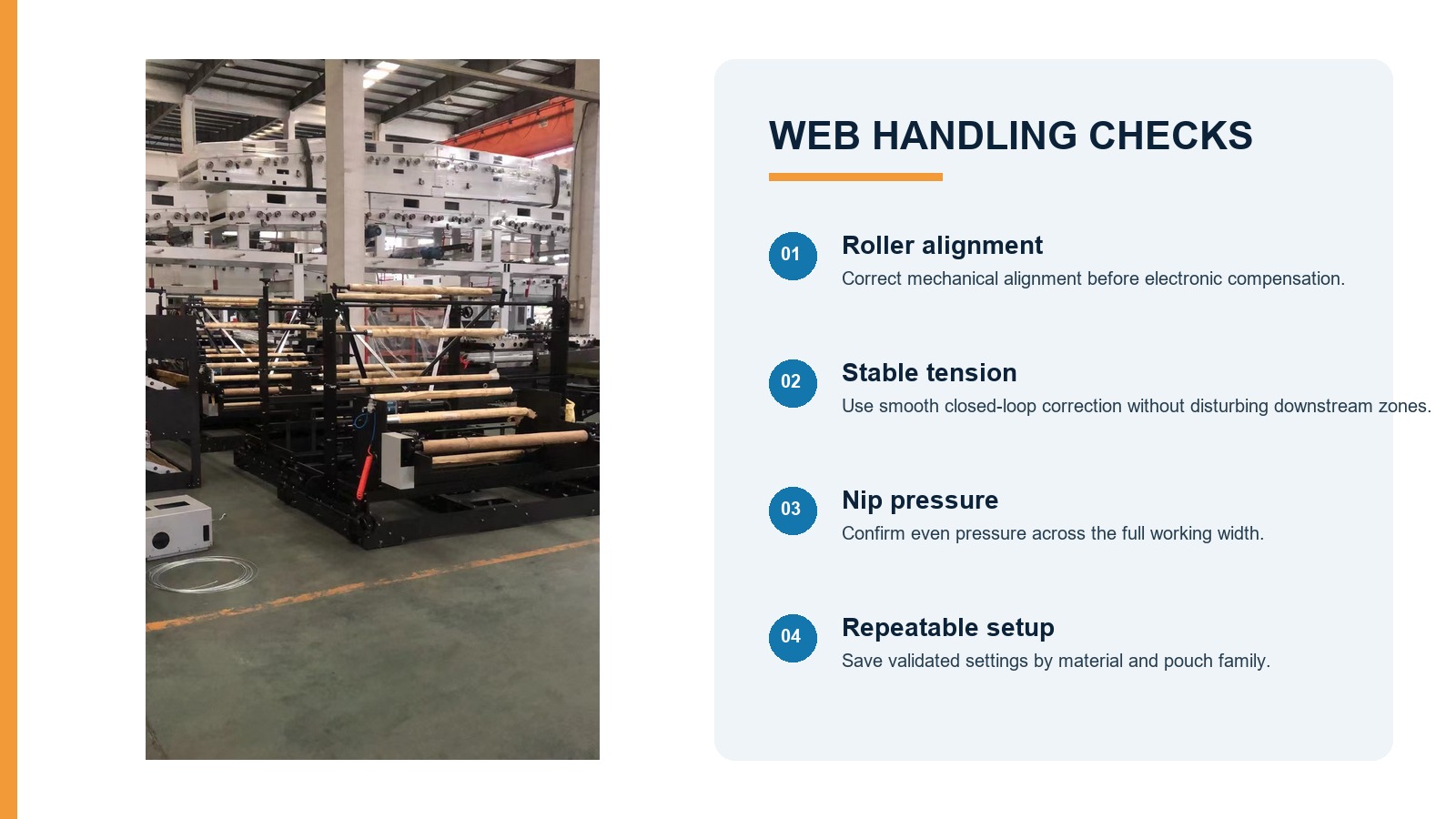
Variable roll diameter, inconsistent material properties, roller alignment, and changing machine speed can disturb tension. Closed-loop servo tension control can compensate for predictable changes, while high-resolution web guiding corrects lateral position. Mechanical alignment and roller condition must be addressed first. A control system cannot permanently correct a damaged roller or a misaligned frame.
Plants should verify pressure distribution across nips and sealing stations, then examine whether correction commands from the guide are too late or too aggressive. The objective is a calm, repeatable web path with minimal correction.
Excessive manual adjustment
Recipe-controlled tooling positions and automatic compensation can reduce repeated set-up work. The most valuable parameters include bag length, temperature zones, seal timing, registration offset, tension, and attachment position. Each recipe needs revision control so a temporary shop-floor change does not become the new standard without review.
A clear interface should show the operator which value changed, the permitted range, and the likely effect. Hiding process relationships behind a simplified screen can make troubleshooting harder.
Inadequate cooling
Plants can increase cooling-roll surface area, improve water or air distribution, and extend the cooling path when the current system cannot remove enough heat. Temperature zones should match the seal pattern and material structure. The correct solution depends on whether the defect begins at sealing, during cooling, or in downstream handling.
Trim and residue handling
Automatic trim winding, chopping, and extraction can reduce manual clean-up and prevent loose material from entering the web path. The system must handle the expected trim width and film characteristics without frequent blockages. Dust and film fragments should be collected away from sensors, sealing surfaces, and electrical cabinets.
Coordination of added functions
Punching, tear features, folding, gusseting, and inspection should share a coordinated machine reference. Recipes can link each function to the relevant bag length and registration data. Alarm logic should identify the failed station and protect the web from unnecessary additional waste.
Development priorities for the next generation of bag making
Sensors and predictive maintenance
Temperature, pressure, vibration, drive load, and web-position data can show gradual change before a line stops. Predictive maintenance becomes credible when the plant links sensor trends to verified failure modes. More sensors without a response plan only increase the volume of unused data.
Digital models may also reduce physical trial time during difficult changeovers. Their value depends on accurate machine, material, and tooling data. Plants should begin with repeatable recipes and reliable measurements before expecting advanced software to optimize the process.
Mono-material packaging
The transition toward recyclable mono-material structures will continue to influence seal design and machine control. Converters will need closer temperature control, better tension management, and material-specific tooling. Qualification work should confirm package performance after filling, storage, transport, and consumer use.
Lightweighting will place similar demands on the process. Reducing film thickness saves material only when the thinner structure still converts consistently and meets the required barrier and mechanical performance.
Continuous production and integrated coating
Continuous or rotary motion can improve output for suitable products by reducing repeated acceleration and deceleration. It also requires precise synchronization and may be less flexible for some complex pouch operations. Equipment selection should follow the actual order mix rather than a preference for the highest stated speed.
Some future lines may integrate functional coating or other upstream processes. This could shorten lead time, but it also joins process steps that traditionally have separate quality checks or curing periods. Plants will need stronger in-line measurement and clear rules for releasing production.
Consumer features and traceability
Reliable reclose systems, laser-scored openings, degassing features, and inserted identifiers can improve package use and traceability. RFID or NFC components may support authentication and interaction in selected applications. These features add cost and control requirements, so they should solve a defined product need.
Materials for demanding conditions
High-barrier structures containing EVOH, special polyamides, or other functional layers may need to withstand retort, aggressive contents, or difficult distribution conditions. Bag making parameters must protect the laminate and produce seals that remain intact throughout the product’s required life. Validation should reproduce the expected filling and use conditions.
A practical improvement sequence
Plants can begin with five steps:
- Define accepted output, start-up waste, downtime, and defect categories consistently.
- Establish a validated process window for each important material and bag family.
- Correct mechanical alignment, tooling condition, and cooling limitations before adding software compensation.
- Save controlled recipes and train operators to understand the critical settings.
- Add automation where recurring data shows that it will remove a specific constraint.
Bag making performance improves when the plant treats tension, sealing, cooling, cutting, attachments, inspection, and handling as one connected process. Stable control protects quality and usually raises useful output at the same time. The best equipment choice is the line that can repeat the required bag specification with acceptable waste, changeover effort, and maintenance demand under real production conditions.