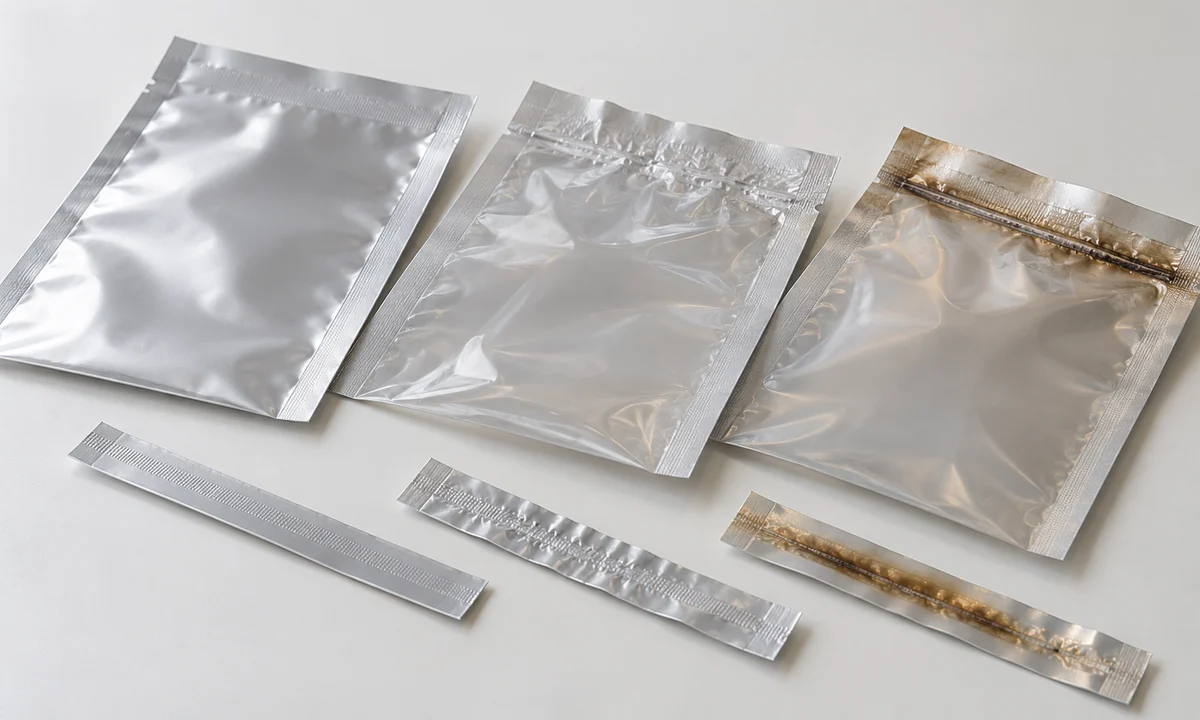
The machine name is only the beginning; the finished pouch usually decides the configuration. Diagnosing bag making machine sealing problems often starts with one question: does the fault come from the film structure or the equipment settings? Applying a mechanical fix to a material mismatch can waste production time and add setup waste.
Cover illustration: intact, wrinkled and overheated pouch-seal examples. This AI-generated image illustrates the topic; it is not a photograph of an actual production test.
Common bag making machine sealing problems and their root causes
Common seal defects include weak or incomplete seals, channel leaks, and burn-through. Leakers tend to occur when the sealant layer does not bond fully across the jaw width, often because of insufficient heat, pressure, dwell time, or contamination. Channel leaks show up as narrow pathways through an otherwise intact seal, and are frequently linked to wrinkling or uneven jaw surfaces. Burn-through can result from excessive heat or dwell time that degrades the outer layers before the inner sealant fuses properly.
Distinguishing material mismatch from mechanical failure
Production teams can start by checking whether a defect repeats at fixed intervals or appears randomly across the web. A repeating defect often points to a damaged sealing jaw, a worn Teflon coating, or a faulty heating element in the machine cycle. Random failures more commonly suggest inconsistent film gauge, poor slip properties, or variable tension upstream of the seal station, although the exact cause depends on the film and the machine.
Equipment selection should start with the finished bag specifications, including material structure, thickness, and any special components, rather than relying on nominal machine speed alone.
Identifying contamination versus thermal inconsistency
Contamination can interfere with molecular bonding even when temperature and pressure appear correct. Dust, ink splatter, or degraded sealant particles may create weak spots that fail under stress testing but look fine visually. Thermal inconsistency tends to produce seals that vary in strength across the same pouch, which may indicate uneven heat distribution or a fluctuating power supply. To tell these apart, examine failed seals under magnification and look for foreign particles versus melted but unbonded layers.
Temperature and dwell time adjustments for laminated films
A hermetic seal generally requires enough energy to pass through the outer substrate and melt the sealant layer without damaging the print or outer film. Thicker laminates may need higher temperatures or longer dwell times so heat can reach the interface where bonding happens. Thinner films often call for more precise control to limit distortion while still allowing enough melt flow for adhesion. Suitable settings depend on the specific film, sealant type, and machine, so the figures should be confirmed through trials.
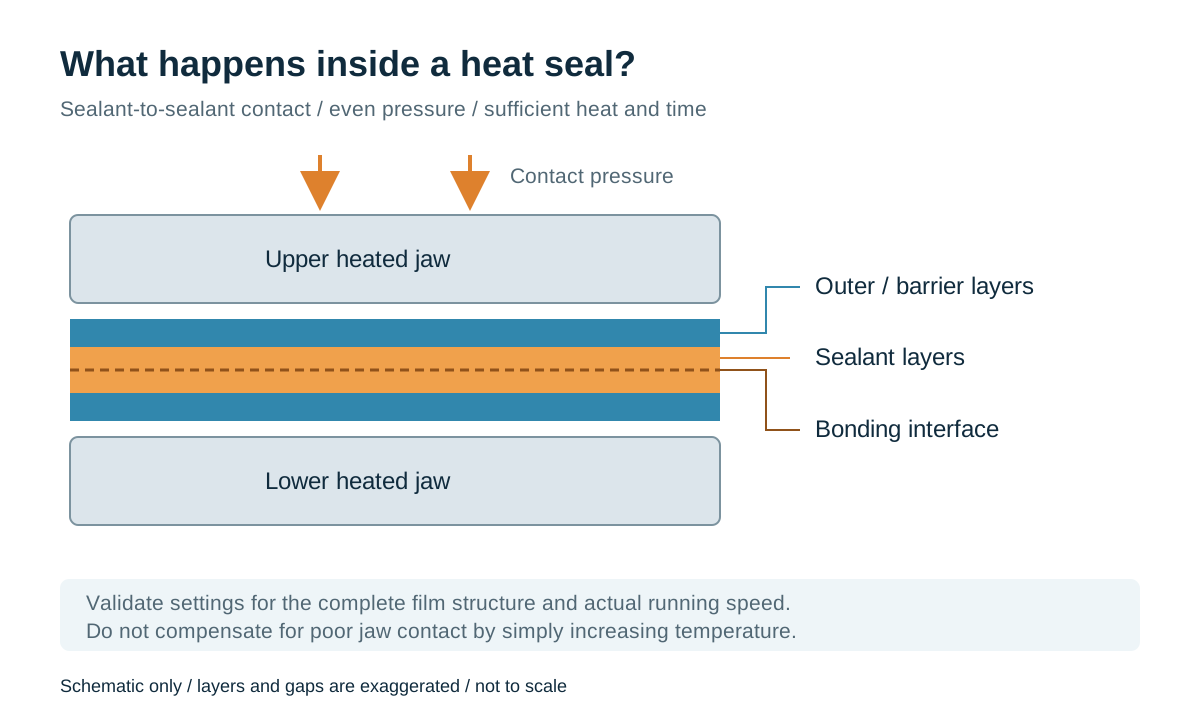
The sealant layers face each other. Heat, contact pressure and dwell time work together. Schematic only; not to scale.
Managing heat transfer through multi-layer structures
Multi-layer laminates can act as insulators that slow heat transfer to the sealant interface. When running structures such as PET/PE or PET/ALU/PE, the sealing temperature may need to account for total gauge and the thermal conductivity of each layer. Aluminum foil conducts heat differently from plastic, but its presence alone is not a reliable reason to select a lower jaw setpoint. Validate the complete laminate under actual production conditions. For thick structures, adjusting dwell time can be more effective than raising temperature, since it may allow heat to soak through with less risk of scorching the surface.
Setting sealing windows for PE mono-materials
Recyclable PE mono-materials can bring a distinct challenge: the sealant and substrate often have similar melting points. These structures typically have a narrower sealing window than traditional PET/PE laminates, which may call for tighter thermal control to avoid distortion or weak bonds. PE mono-material and other recyclable structures should ideally go through a material trial and sealing-window confirmation, because they can process differently than traditional laminates. Running them outside their validated parameters may lead to chronic sealing problems that jaw adjustment alone is unlikely to resolve.
A higher nominal machine speed does not necessarily lower unit cost if the sealing window narrows at that rate.
Mechanical alignment and pressure distribution checks
Thermal settings may not be able to make up for physical misalignment at the seal station. Even with a well-chosen temperature profile, uneven pressure distribution can create channels and leakers that lead to rejected batches. Mechanical verification is often worth doing before any process parameter change, so a plant is less likely to chase a thermal problem that was never thermal.
Before touching sealing jaws or inspecting their contact surfaces, follow the machine’s shutdown, isolation, and cooling procedures.
Verifying sealing jaw parallelism and surface condition
Sealing jaws generally need to sit parallel to apply even pressure across the full web width. Operators can check jaw flatness with a straightedge and inspect Teflon coating condition after material changeovers, or at intervals suited to the application. Worn coatings can cause sticking and localized cooling, which may weaken specific areas of the seal. Uneven wear patterns can also suggest an alignment problem that fresh tape alone may not resolve.
Web guiding and tension stability at the seal station
Inconsistent web tension or poor registration upstream can show up as intermittent sealing failures at the jaw. If the film wanders sideways just before entering the seal zone, the jaw may catch varying amounts of material and produce asymmetric seals. Tension spikes can briefly stretch the film, thinning the sealant layer at that point and potentially reducing bond strength there. Stabilizing web handling upstream may clear up some sealing faults that are otherwise attributed to jaw temperature.
Material structure compatibility with pouch machine families
Not every machine handles every laminate or closure type equally well. Different machine families are generally built for particular material ranges and sealing mechanics, and combining an incompatible structure with a machine often leads to persistent quality problems. Understanding these boundaries early can help avoid costly retrofits.
Limitations of standard machines for heavy-gauge laminates
Standard pouch machines are typically designed with limits on maximum film thickness and sealing pressure. The three-side-seal and multifunction laminated pouch machine is configured around compatible laminated structures, but its material and gauge range should be confirmed for each application. Heavy-gauge pet food or industrial pouches may require reinforced frames and higher-pressure cylinders, which are more commonly found on specialized equipment. Running thick structures on a machine that is not rated for them can accelerate wear and may produce inconsistent seals even when parameters are carefully tuned.
Specialized sealing requirements for zippers and valves
Adding a zipper, valve, or spout introduces sealing variables that should be checked against the machine’s capabilities before production starts. A stand-up and zipper pouch making machine typically integrates profile feeding and crush-seal stations that a standard machine may lack. Three-side-seal, stand-up zipper, and eight-side-seal flat-bottom pouches use different forming and sealing arrangements. Confirm the pouch format against the exact machine configuration rather than assuming that one model covers every format. Confirming the closure supplier, profile dimensions, and feeding method early can help avoid discovering an incompatibility during installation.
This approach does not remove the need for operator skill or routine maintenance on any machine family.
Troubleshooting checklist for production teams
Systematic diagnosis can reduce downtime when sealing problems show up during a changeover or mid-run. Production teams may find it useful to follow a logical sequence that rules out simple causes before touching complex parameters, which helps limit wasted film and unnecessary part replacement.
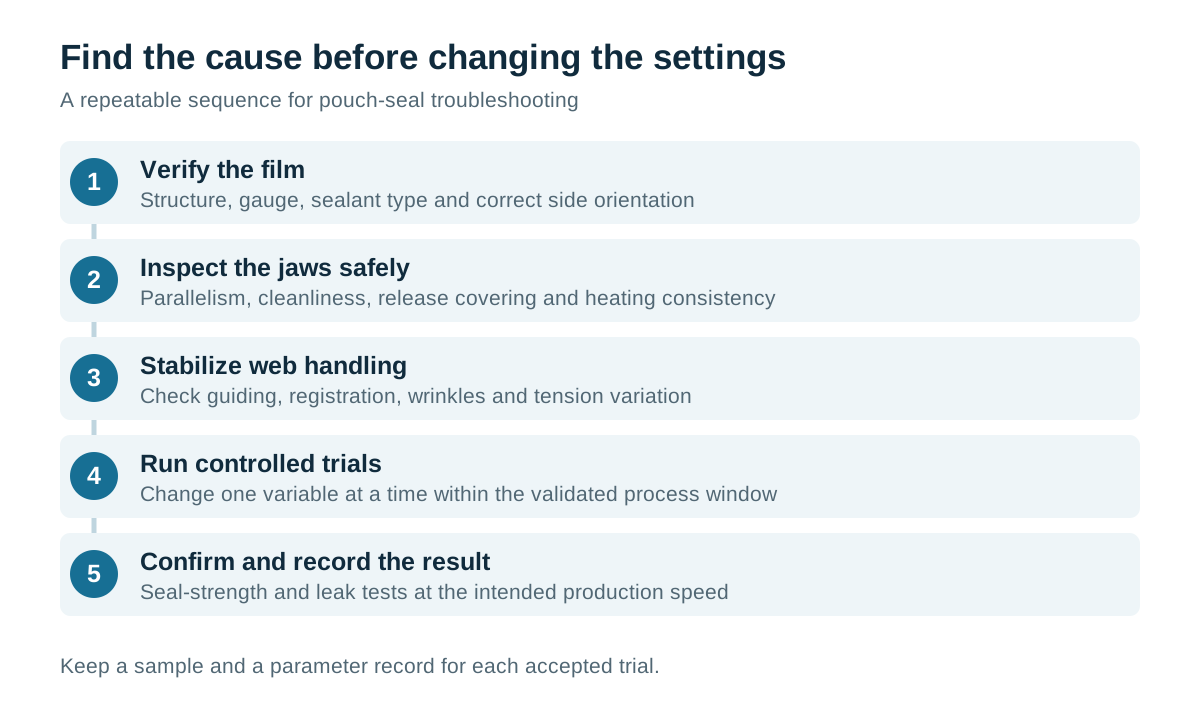
Change one variable at a time and confirm acceptable seals at the intended production speed.
-
Verify the film specification matches the work order: gauge, sealant type, and treated-side orientation where applicable.
-
Inspect sealing jaws for parallelism, Teflon condition, and even heating across the full width.
-
Check web tension and guiding stability immediately upstream of the seal station.
-
Run a short test at reduced speed to help isolate whether the issue is thermal, mechanical, or material-related, then reconfirm the result at the intended production speed.
-
Document parameter changes and the matching seal test results, to build a record for future runs.
Frequently asked questions about pouch sealing
Why do seals fail only on one side of the pouch?
Asymmetric seal failure often points to uneven jaw pressure or misaligned web tracking. One jaw may be worn, tilted, or receiving less cylinder force than its counterpart. Film wandering just before the seal station can also expose one edge to different conditions than the other. In these cases a mechanical inspection is usually a better first step than a temperature adjustment.
How does film thickness affect machine speed and seal integrity?
Thicker films generally need more energy to reach sealant melt temperature, which can limit stable running speed. As gauge increases, dwell time may need to lengthen or temperature may need to rise, and either can reduce maximum output. Running too fast for a given thickness can produce cold seals that pass visual inspection but fail a leak test. Speed ratings typically assume suitable material and structure conditions.
What information is needed to validate a new material structure?
Validating a new structure usually takes actual film samples, complete lamination details, and target pouch dimensions. We need to confirm sealant type, total gauge, and any barrier layers to recommend a suitable jaw configuration and heating profile. Without physical samples, recommendations remain theoretical and carry a higher risk of problems during commissioning. Material trials help establish the real sealing window before full production begins.
Send your bag details for a machine proposal
Accurate equipment recommendations depend on verified application data, not general specifications. Please send bag details for a machine proposal including bag samples, dimensions, material structure, required functions, and target output through our contact page or WhatsApp +86 139 0617 3618 (https://wa.me/8613906173618).